
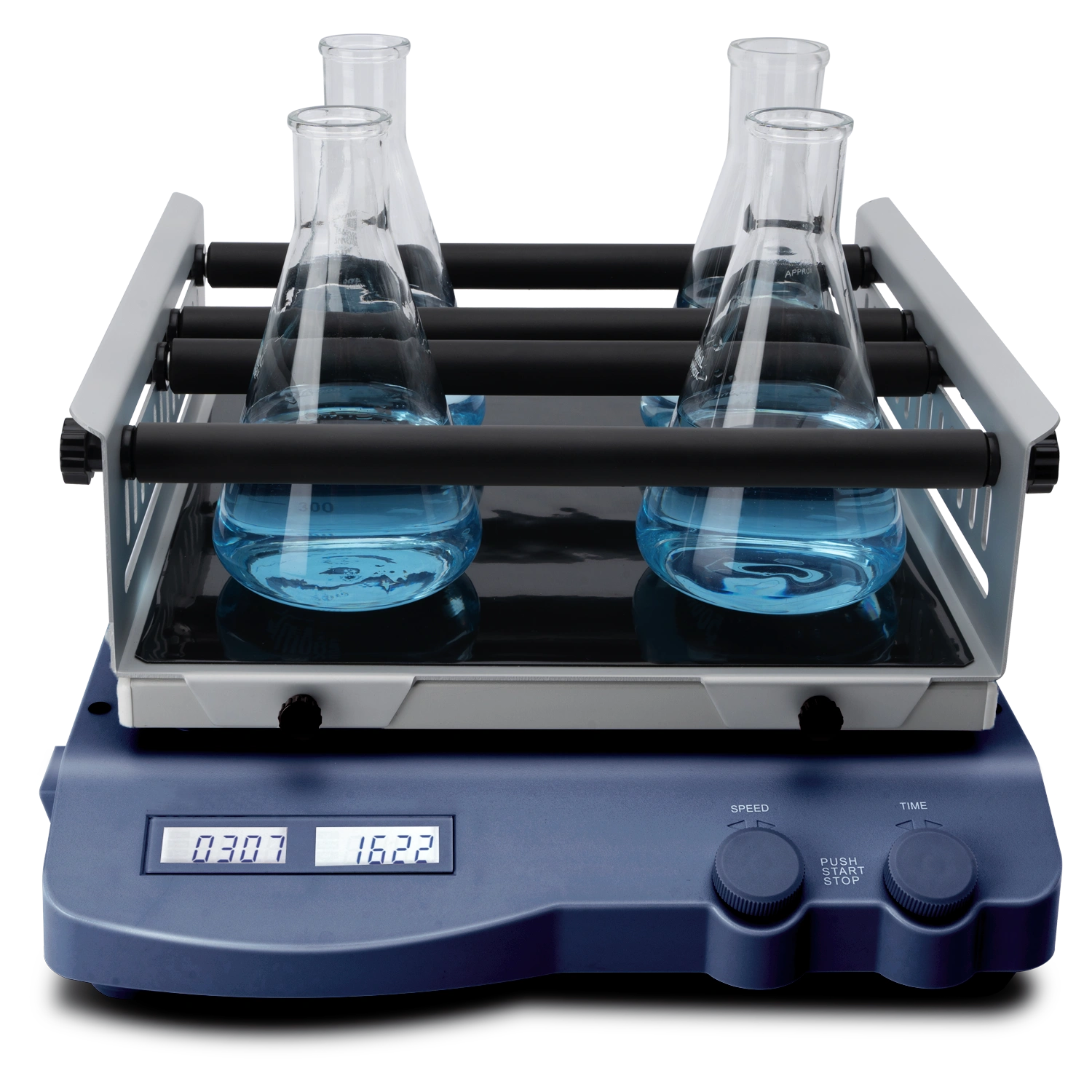
Multifunctional Track-type Decolorizing Shaker
Scalable manufacturing capabilities for laboratory shakers. Ideal for any rotary evaporator supplier requiring precise orbital mixing for pilot scale rotary evaporator workflows.
View productThe L1000TC-S Thermal Cycler Standard is a 96-well benchtop platform listed at $6434.30 for routine amplification in mid-budget labs. If your procurement team is shortlisting a thermal cycler manufacturer, the modules below lay out the temperature, control, consumable and service facts to verify before you commit. The same framework is what you need when screening a pcr thermal cycler supplier for private-label, distributor or volume programmes, including the one gradient claim that still has to be confirmed in writing.

Eight checks that separate a documented thermal cycler manufacturer from a trading listing. Use this list as the question set for your first supplier meeting.
Ask for written block uniformity and accuracy figures. The L1000TC-S states <0.3℃ uniformity at 55℃ and ±0.1℃ display accuracy.
Confirm the control method, not just the sensor. L1000TC-S uses thermoelectric semiconductor PID control with edge temperature compensation.
Request the batch test record covering ramp rate and block uniformity so incoming units can be checked against the same numbers.
Verify the block accepts your existing plastics without a swap: 96×0.2mL tubes, 12×8-strip tubes and 96-well plates.
Check the supply covers every territory you ship to. L1000TC-S is rated 100~120V / 200~240V 50/60Hz with no external transformer.
Confirm what the instrument does and does not do: L1000TC-S has no USB or Wi-Fi ports and no host computer control system — programs are stored locally.
Agree warranty length, heated-lid and block spares, calibration support and the first-line response path for your region.
Ask for sample validation capability, packaging and labelling scope, UI language options and the lead time attached to each.
One page of verified parameters, so your technical reviewer can compare the platform against an internal requirement list.

Thermal Cycler Standard L1000TC-S — 96-well aluminium alloy block, 7-inch touch panel, desktop footprint.
“Standard entry-level PCR device for mid-budget labs conducting routine ordinary amplification assays.” Treat this as a routine-amplification instrument, and budget for gradient-capable models only if your workflow genuinely needs a temperature gradient across the block.
| Parameter | L1000TC-S specification |
|---|---|
| Compatible consumables | 96×0.2mL single tubes, 12×0.2mL 8-strip tubes, 0.2mL 96-well microplates (skirtless / semi-skirted / fully skirted) |
| Heating temperature range | 4–105℃ |
| Lid temperature range | 30–110℃ |
| Temperature display accuracy | ±0.1℃ |
| Well uniformity @ 55℃ | <0.3℃ |
| Max heating / cooling rate | 5℃/sec |
| Gradient zone setting | Not listed in the parameter table — see the verification module below |
| Segments per program | Up to 30 temperature segments, up to 99 cycles |
| Storable programs | Over 200 user-defined programs |
| Control method | Thermoelectric semiconductor PID control with edge temperature compensation |
| Display / input | 7-inch colour touch LCD, 800×480, touch-only panel with no physical buttons |
| Lid behaviour | Auto lid closing when block temperature drops below 30℃ |
| Block material | Aluminium alloy |
| Power-off protection | Automatically resumes unfinished cycles after power recovery |
| Host computer / ports | No built-in upper computer control; no USB or Wi-Fi interfaces |
| Voltage / frequency | Auto-adaptive 100~120V / 200~240V, 50/60Hz |
| Dimensions / net weight | 280×370×250mm / 11kg |
| Ambient conditions | 5–40℃, ≤80%RH non-condensing |
| Protection class | IP20 |
Listed price on the product page: $6434.30. Confirm current pricing, configuration and availability with the supplier before issuing a purchase order.
Three routes buyers typically take with a benchtop PCR platform. Each one lists what to put in writing before any tooling or volume commitment.
Confirm at RFQ: minimum order quantity, artwork approval steps, lead time and whether a branded sample unit can be supplied before full production.
Confirm at RFQ: engineering scope, whether firmware or protocol-level changes are involved, sample validation plan and the longer lead time that follows.
Confirm at RFQ: annual volume bands, stocking terms, warranty handling in your territory and the escalation route for repairs.
Send your assay profile, target territory and expected annual volume, and request a tailored OEM or ODM quotation with sample validation included.
Every application below is one the product page states for this instrument. Use the fourth column as the buyer decision you still have to make.

| Application | How the platform fits | Plan for |
|---|---|---|
| Gene detection | Tight well-to-well uniformity for repeatable amplification signals across a full 96-well plate | Decide plate versus strip workflow; confirm the 30-segment limit covers your cycling profile |
| Molecular cloning | 5℃/sec ramp with a Long PCR extension window from -9min59s to +9min59s | Check long-amplicon extension times against your standard protocol |
| Gene expression | Dual selectable control modes — block bulk temperature control for high-throughput screening, single-tube control for micro fine amplification | Choose which control mode your expression panel needs |
| Site-directed mutagenesis | Long PCR support plus power-off protection that resumes interrupted cycles after a power cut | Value the recovery feature if runs sit unattended overnight |
| University molecular teaching | 11kg desktop unit with a 7-inch touch interface and over 200 stored methods for one-click recall by students | Budget bench space (280×370×250mm) and plan a shared method library |
| Food microorganism testing | Routine ordinary amplification on standard 0.2mL plastics and 96-well plates | Confirm your test kit chemistry runs on a non-gradient routine profile |
| Agricultural breeding | 96-well plates with skirtless, semi-skirted or fully skirted formats, no block swap needed | Standardise on one plate format across screenings |
| Drug discovery screening | Block bulk temperature control for high-throughput plate runs with one-click protocol recall | Assess whether local-only program storage suits your record-keeping process |
Application statements come from the product page. Consumable and control-mode choices remain the buyer’s decision and should be validated against your own assay.
The product page carries two statements about gradient support. Split them before you write the gradient function into a purchase specification.
Sample block detail. Consumable compatibility is confirmed for 96×0.2mL tubes, 8-strip tubes and 96-well plates.
Gradient is useful when you are optimising annealing temperature for a new primer pair, working with GC-rich templates, or running several annealing conditions in parallel. If your lab runs fixed, validated routine protocols, a non-gradient block will not limit your throughput — and that is the scenario this platform is positioned for.
A five-step path that gives the supplier everything needed to return an accurate quotation and a validation plan.
Target type, amplicon length, plate or strip format, and expected weekly throughput.
Block format, voltage for each territory, lid behaviour and program storage requirements.
Ask for a validation run on your primer set, and written confirmation of gradient behaviour.
OEM path, minimum order quantity, lead time, packaging, branding and spare-parts content.
Warranty length, calibration support, first-line response and the territory repair route.
Include your assay details, destination countries and expected volumes so pricing, lead time and OEM scope can be quoted in one pass.
Keep adjacent product options together for a faster catalog comparison.
Scalable manufacturing capabilities for laboratory shakers. Ideal for any rotary evaporator supplier requiring precise orbital mixing for pilot scale rotary evaporator workflows.
View product
Ensure precise environmental control with our laboratory incubator. As a professional laboratory incubator supplier, we provide stable, programmable solutions.
View product
Labcarta Blast Drying Oven features forced air circulation for uniform heating and efficient drying. It is widely used for sample drying, baking and sterilization. With stable performance, this constant temperature drying oven…
View productAsk for written temperature performance data, the control architecture, a batch qc record, consumable compatibility, voltage rating, spare-parts and warranty terms, and evidence of oem or private-label work. For this platform the stated figures are <0.3℃ well uniformity at 55℃, ±0.1℃ display accuracy and thermoelectric semiconductor pid control with edge temperature compensation.
The parameter table lists a 4–105℃ heating temperature range, a 30–110℃ lid range, ±0.1℃ temperature display accuracy, <0.3℃ well uniformity at 55℃, and a maximum heating and cooling rate of 5℃ per second.
The page contains two different statements. The feature copy describes touchdown pcr with a ±9.9℃ gradient, while the parameter table lists “no gradient zone setting function.” long pcr with a -9min59s to +9min59s extension window is stated in both places. Request written confirmation of gradient behaviour before specifying touchdown workflows, and validate on your own primer set.
The block accepts 96×0.2ml single pcr tubes, 12×0.2ml 8-strip tubes, and 0.2ml 96-well microplates in skirtless, semi-skirted and fully skirted formats without block replacement.
No. The l1000tc-s uses an auto-adaptive 100~120v / 200~240v, 50/60hz supply, so the same unit can be deployed across different regional power standards without an added transformer. The unit also has no usb or wi-fi ports and no host computer control system — programs are created and stored on the instrument itself.
Contact labcarta through the contact page with your assay profile, target territories, expected annual volume and any oem or private-label requirements. Ask specifically for a validation run and written confirmation of the parameters that matter to your protocol — including the gradient question — before you finalise the purchase specification.
